Bakery Machinery Buying Guide
A practical checklist for evaluating bakery machinery before you buy — capacity, construction, power, automation, safety, hygiene, spare parts, warranty and total cost of ownership.
- How to evaluate bakery machinery
- Choosing the right product type
- Batch vs. continuous requirements
- Machine construction
- Power & utility requirements
- Automation level
- Maintenance & spare parts
- After-sales support
- Safety features to check
- Hygiene considerations
- Certifications & warranty
- Evaluating a supplier
- Total cost of ownership
- Questions to ask before you buy
- Next step
How to Evaluate Bakery Machinery
Bakery machinery is a long-life capital purchase — most well-built ovens, mixers and dough-processing equipment stay in service for years. That makes the buying decision less about comparing a spec sheet line by line and more about matching a machine's capacity, construction and support model to how your bakery actually runs. This guide walks through the factors worth checking before you commit, in roughly the order they matter.
Choosing the Right Product Type
Start from what you need the machine to do, not the category name:
| If you need to... | Consider |
|---|---|
| Bake bread, buns, cookies, cakes or rusk evenly at scale | Rotary Rack Ovens (18 to 172 trays, gas/diesel/electric) |
| Mix creams, batters, doughs or fillings with interchangeable attachments | Planetary Mixers (20–200 litre range) |
| Develop strong gluten structure for bread, pizza, bun or rusk dough | Spiral Mixers (30–150 kg flour capacity) |
| Give dough a controlled final proof before baking | Proofers (table-top to 12-trolley) |
| Portion, round or shape dough between mixing and proofing | Dough Processing (dividers, rounders, moulders, bowl lifters) |
| Slice baked bread into uniform slices | Bread Slicers (manual to fully automatic) |
| Automate depositing for cookies or cakes | Cookie & Cake depositors and batter pumps |
Batch vs. Continuous Production Requirements
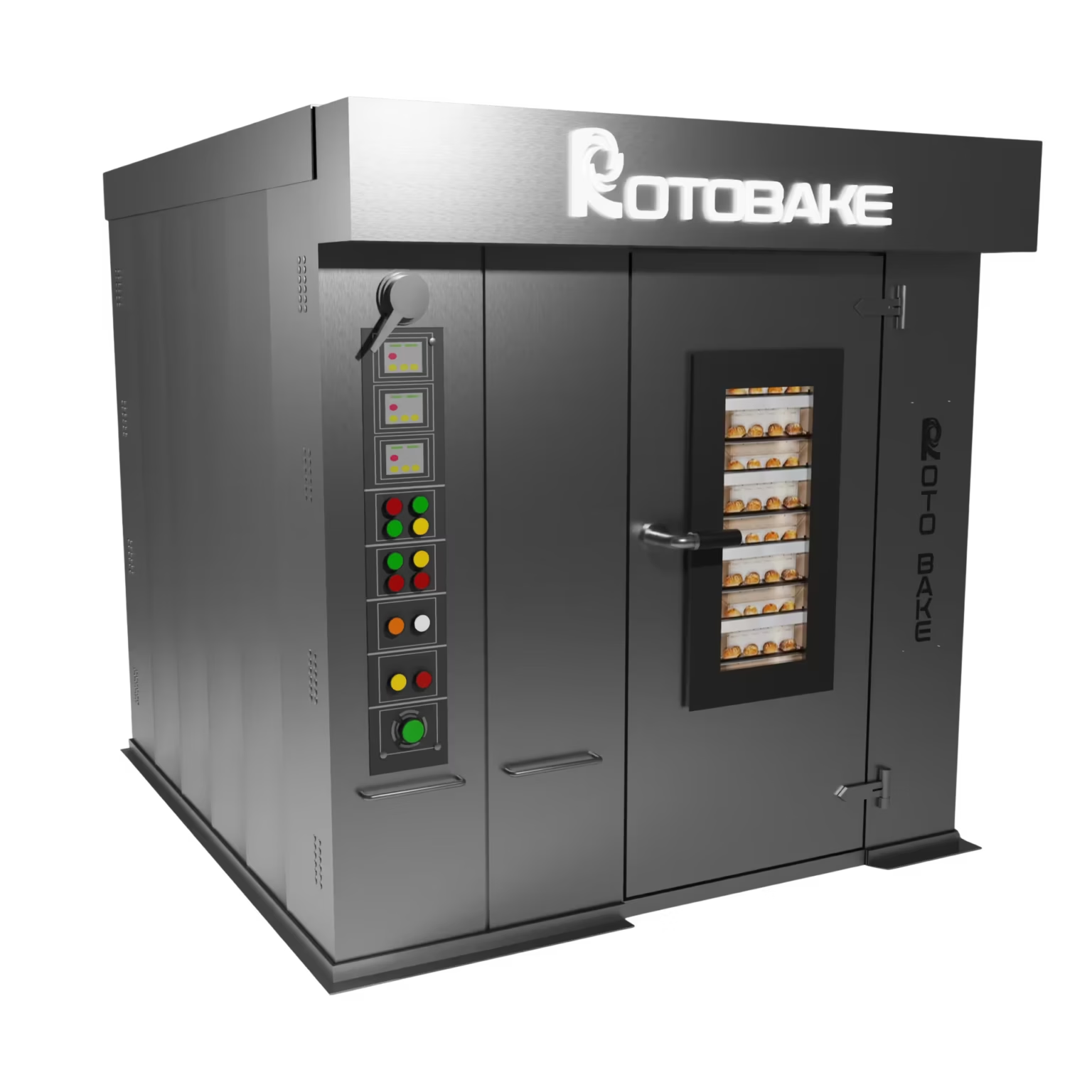
Rotary rack ovens (and most of the machinery on this site) are batch equipment — a set of trays is loaded, baked through a cycle, and unloaded before the next load goes in. For most commercial bakeries, sizing enough tray capacity and running enough cycles per shift comfortably meets daily output targets without needing continuous (in-line, non-stop) baking equipment. If your production line needs continuous material handling around the oven — panning, conveying, depanning, cooling — RotoBake's industrial solutions range covers that equipment separately from the core batch oven.
Machine Construction
- Steel grade — food-contact surfaces should be food-grade steel; many mixers and proofers use SS304 stainless steel specifically, which resists corrosion under repeated wash-down.
- Weld and frame quality — smooth, continuous welds are easier to clean and less prone to cracking under vibration than spot-welded or bolted-together frames.
- Motor and drive rating — ask for the motor power (kW) and drive type for any moving mechanism; this affects both duty cycle and running cost.
- Electrical standard — confirm the supply requirement (for example, a 415V / 3-phase / 50Hz supply is a common industrial standard) matches your site before ordering.
Power & Utility Requirements
Rotary rack ovens are available in gas, diesel or electric versions depending on the model — check each machine's own Fuel Options field rather than assuming every model in a range supports every fuel type. Beyond the oven, confirm your site's electrical supply matches each machine's rated requirement, and that you have adequate water, drainage and ventilation for mixing, wash-down and oven exhaust.
Automation Level
Within most categories there's a range from manual to fully automatic. RotoBake's bread slicers, for example, span manual, semi-automatic and fully automatic models, and the planetary mixer range spans geared 3-speed, VFD multi-speed and high-speed lines. A higher automation level generally reduces labour dependency and improves consistency, but costs more up front — match the level to your actual production volume and available operators rather than defaulting to the most automated option.
Maintenance & Spare Parts
Before buying, ask any supplier how long they guarantee spare-parts availability and how quickly parts can be dispatched to your location. As one documented example, RotoBake guarantees original spare-parts availability on all current models for 10 years from purchase, dispatched to any port within 5 working days — see our certifications for the full detail. Use that as a benchmark when comparing other suppliers' after-sales commitments, not as a claim that every supplier offers the same terms.
After-Sales Support
Installation, commissioning and operator training materially affect how quickly a new machine reaches full production. Ask whether the supplier installs and commissions on site and trains your operators as part of the purchase, or whether that is arranged separately at extra cost and lead time.
Safety Features to Check
- Physical guarding around moving parts (belts, drives, mixing mechanisms)
- An accessible emergency-stop (E-stop) control
- Interlocks that prevent operation with a guard or door open
- Clear operating and safety instructions supplied with the machine
Hygiene Considerations
For any food-contact machine, check the construction material (stainless steel such as SS304 is standard on RotoBake's proofers and widely used across the industry for food-contact parts), whether surfaces are smooth and free of product traps, and how easily the machine can be dismantled for cleaning access.
Certifications & Warranty
Ask any supplier for verifiable certification documents rather than taking a certification claim at face value. As a documented example, RotoBake's manufacturing operates under ISO 9001:2015 quality management, carries CE marking on applicable export models, meets BIS registration for the Indian domestic market, and holds EEPC India export-body membership — see the full detail on our About Us page. On warranty specifically, confirm in writing what is covered, for how long, and whether spare-parts availability is guaranteed beyond the warranty period itself.
Evaluating a Supplier
- How long has the supplier been manufacturing this category of equipment? (RotoBake, for example, has manufactured bakery machinery since 1964 as Bharat Engineering Works — a fact specific to us, not a claim about the industry generally.)
- Do they manufacture in-house, or resell/trade equipment made by others?
- Do they have export experience relevant to your region, if you're buying internationally?
- Can they provide full technical specification sheets before you order, not just after?
- Do they offer a documented after-sales and spare-parts commitment in writing?
Total Cost of Ownership
The purchase price is only one part of what a machine costs over its working life. A fuller picture includes:
- Purchase price and any installation/commissioning charges
- Ongoing fuel or electricity cost for the automation and fuel type you choose
- Spare-parts cost and availability over the machine's expected working life
- Routine maintenance and any service contract cost
- Operator training, both initial and for staff turnover
Questions to Ask Before You Purchase
- What is this model's rated capacity, and under what conditions was that figure measured?
- What warranty and spare-parts guarantee applies, and for how long?
- What is the current lead time from order to delivery?
- Is on-site installation, commissioning and operator training included?
- What certifications can you provide documentation for?
- Can you provide references or examples of similar installations in my region?
- What is the process if a part fails after the warranty period?