Home About Us Products Industrial Solutions Guides Contact 📞 Get a Free Quote
HomeRusk Production Machinery Guide
Bakery Machinery Guide

Rusk Production Machinery: A Complete Guide

How commercial rusk is actually made — from dough mixing through to second-bake drying and packing — and where RotoBake's rotary rack ovens, mixers, dough processing and slicing machinery fit into that line.

What Makes Rusk Production Different From Bread Baking

Rusk (also sold as toast or zwieback-style bread) is a twice-baked bread product. A dough is mixed, proofed and baked into a loaf in much the same way as ordinary bread — that part of the line is close to a standard bread production setup. What makes rusk different is everything after the first bake: the loaf is cooled, sliced, and then baked a second time at a lower temperature for a longer dwell time. This second bake drives out most of the remaining moisture, which is what gives rusk its long shelf life and characteristic dry, crisp texture without refrigeration.

Because of that two-stage bake, a rusk line has two decisions a standard bread line doesn't: how much first-bake oven capacity you need, and how you handle the loaf between the first and second bake (cooling, slicing, and a second baking or drying stage). The sections below walk through each stage and the RotoBake machinery relevant to it.

This guide describes the general rusk production process and RotoBake's own published machine specifications only. It does not include invented capacities, prices, or certifications for any equipment. Exact throughput for your recipe and slice format should always be confirmed directly with RotoBake before you finalise a line.

The Rusk Production Process, Step by Step

Below is the typical sequence for a commercial rusk line, with the RotoBake equipment category that serves each stage. Not every bakery needs every machine listed — smaller operations often combine steps manually, while larger lines automate each stage separately.
Step 1
Raw material handling & dough preparation
Flour, water, yeast and other ingredients are weighed and prepared before mixing. RotoBake's accessories range — stainless steel storage containers and raw-material trolleys — supports ingredient handling ahead of the mixer.
Step 2
Dough mixing
Rusk dough is typically developed on a spiral mixer for strong gluten structure, or on a planetary mixer depending on your recipe and batch size. RotoBake's spiral mixer range is built for bread, pizza, bun and rusk dough specifically.
Step 3
Dividing & moulding
The mixed dough is portioned on a hydraulic dough divider and shaped on a dough moulder before panning. See RotoBake's dough processing range — dividers such as the RB-DD-700-4 and moulders such as the RBDM-1000.
Step 4
Proofing
Panned dough proofs under controlled temperature and humidity before baking. RotoBake's proofer range runs from a compact table-top unit to a twelve-trolley model, sized to match your oven's tray-load cycle.
Step 5
First bake
The proofed loaves are baked in a rotary rack oven. Every RotoBake rotary rack oven — from the RBO-36 up to the RBO-136 — publishes a dedicated Rusk Capacity specification on its technical data sheet (see the table below), alongside its standard bread and cookie output figures.
Step 6
Depanning & first cooling
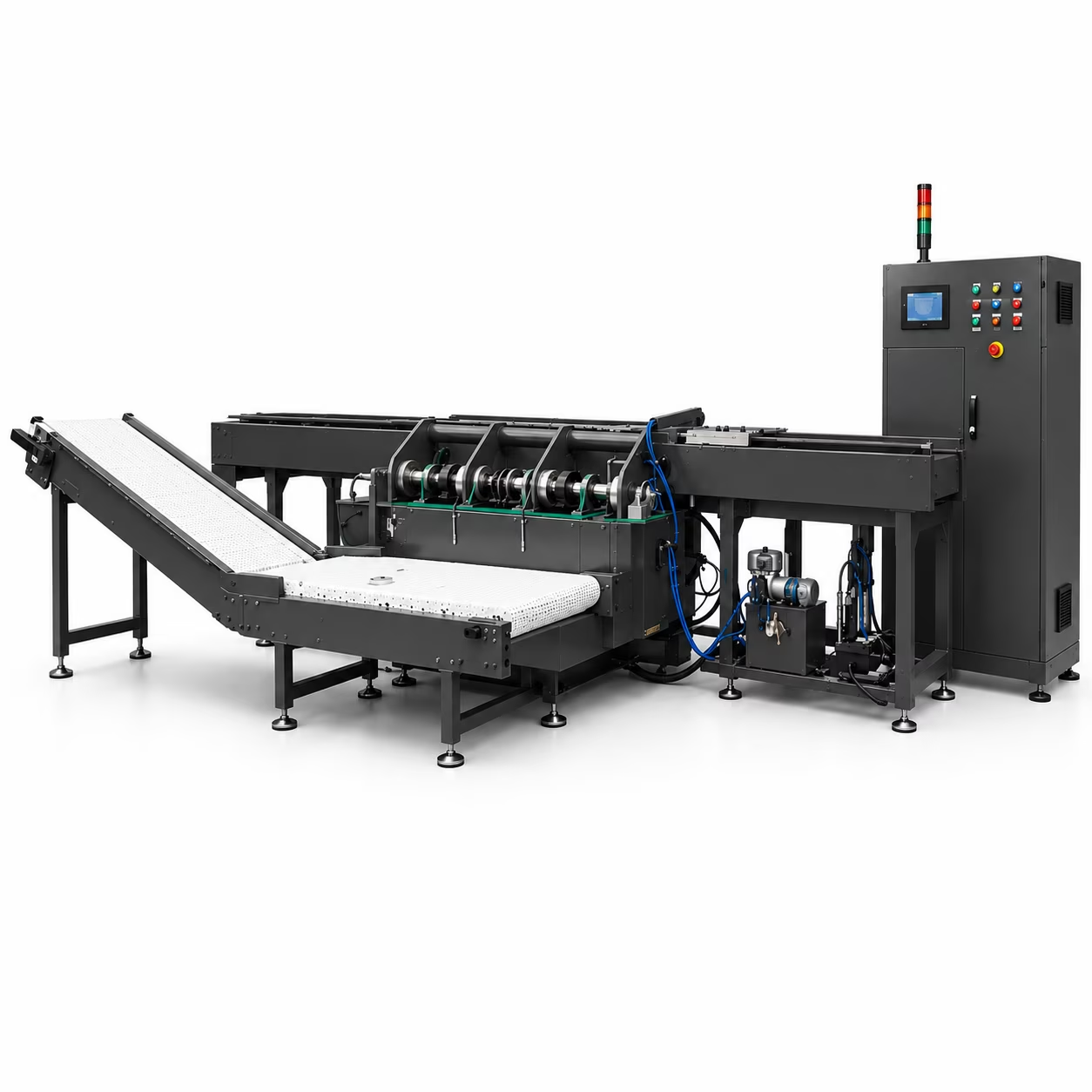
Baked loaves are removed from their moulds before slicing. RotoBake's Rusk Depanner, part of our industrial solutions line, is purpose-built for this — it extracts baked rusk loaves from long gang moulds and returns the empty moulds to panning automatically.
Step 7
Slicing
The cooled loaf is sliced into individual rusk pieces before the second bake. See RotoBake's bread slicer range, including the automatic high-speed bread slicer and the semi-automatic jumbo slicer, both with adjustable slice thickness.
Step 8
Second bake (toasting / drying)
Sliced pieces go through a second, lower-temperature, longer-dwell bake that removes the remaining moisture and gives rusk its shelf-stable crunch. Depending on your line configuration, this second bake can run on a rotary rack oven at an adjusted temperature setting. Discuss your specific first-bake and second-bake split with RotoBake when requesting a quote — the right setup depends on your recipe and target shelf life.
Step 9
Final cooling
Rusk must cool fully after the second bake before packing, to avoid trapping residual moisture in the pack. RotoBake's industrial solutions line includes cooling systems for higher-throughput lines.
Step 10
Packing
Finished rusk is weighed and packed. RotoBake's stainless steel working tables and storage containers support this finishing stage; dedicated automatic packing machinery is outside RotoBake's current product range.
RotoBake Rusk Depanner — removes baked rusk loaves from gang moulds after the first bake
RotoBake's Rusk Depanner extracts baked rusk loaves from long gang moulds after the first bake, ahead of slicing and the second bake.

Rusk Capacity by Oven Model

Every RotoBake rotary rack oven publishes a Rusk Capacity figure on its technical specification sheet, alongside its standard bread and cookie output. These figures come directly from each model's published product page — nothing below has been estimated for this guide.

ModelTray CapacityRusk CapacityFuel Options
RBO-3636 trays350 kg per 24 hrsDiesel / Gas / Electric
RBO-4444 trays420 kg per 24 hrsDiesel / Gas / Electric
RBO-7272 trays600 kg per 24 hrsDiesel / Gas / Electric
RBO-8888 trays800 kg per 24 hrsDiesel / Gas
RBO-136136 trays1,400 kg per 24 hrsDiesel / Gas

RotoBake manufactures nine rotary rack oven models in total (18 to 172 trays) — see the full rotary rack oven range for models and specifications not listed in this table.

Production-Line Considerations

⚖️
Match mixer output to divider throughput
A mixer batch that's too large for your divider (or too small to keep it fed) creates bottlenecks either upstream or downstream. Size your mixer bowl capacity against your divider's rated throughput, not the other way round.
🌡️
Size proofer trolleys to your oven's cycle time
Your proofer needs enough trolley capacity to keep a fully-proofed batch ready every time the oven completes a bake cycle — otherwise the oven sits idle waiting for dough.
🔥
Decide your first-bake / second-bake split early
Whether you run both bakes on the same oven type (at different settings) or dedicate separate ovens to each stage affects your total oven count and floor layout — settle this before you size equipment.
🔪
Slice thickness affects second-bake time
Thinner slices dry faster in the second bake; thicker slices take longer. Your bread slicer's thickness setting and your second-bake dwell time need to be planned together, not independently.

Capacity Planning Basics

A useful way to plan a rusk line is to work backward from your target finished (packed) output per day:

  1. Start with your target finished rusk output per day (in kg or units).
  2. Remember that the second bake removes additional moisture, so your line's first-bake bread output must be higher than your finished rusk weight — the exact reduction depends on your recipe, slice thickness and drying time, so this should be confirmed with test batches rather than assumed.
  3. Use the oven's published Rusk Capacity figure (see the table above) to shortlist a model, or combine multiple ovens for higher output.
  4. Size your mixer, divider, moulder and proofer to keep that oven fed every cycle — see the dough processing range and proofer range for the matching capacities.
RotoBake does not publish a single universal "kg of dough in → kg of rusk out" conversion figure, because it depends on your specific recipe and process. For an accurate capacity plan for your target output, share your requirement directly with our team.
Planning a rusk production line?
Tell us your target daily output and we'll help you shortlist the right oven, mixer, dough-processing and slicing combination.